
Warren County Parole Versus Probation
Parole follows a state-prison sentence. The New Jersey State Parole Board decides whether an eligible person may leave prison on a future Board-set date and then supervises that person in the community. Probation is imposed by a judge and administered by the New Jersey Judiciary. It can be the main sentence, or it can follow a county jail term. Both statuses can exist after physical release, but neither is a substitute for the Warren County Correctional Center’s release entry.
The source of the decision controls where to verify it. An NJDOC incarceration history can show when a state prisoner left custody, while the Parole Board confirms present parole supervision. A criminal judgment can show that a Warren County defendant received probation, while the Warren Probation Division handles the active case. A court order and a jail door-out record answer related but different questions.
| Point | Parole | Probation |
|---|---|---|
| How it begins | Release from state imprisonment under a Parole Board decision or statutory supervision | A sentence entered by a court, with or without a county jail component |
| Warren County authority | New Jersey State Parole Board | New Jersey Judiciary, Warren Probation Division |
| Public starting record | NJDOC history and Date Out-of-Custody | Criminal judgment and public court case |
| What release means | Prison confinement ended, but supervision and legal custody may continue | The person remains in the community under court conditions |
- Parole
- Community release from a state-prison term under Board supervision.
- Probation
- A court sentence served in the community under a probation officer.
- Discharge
- The formal end of the applicable sentence or supervision term.
- Absconder
- A supervised person alleged to have stopped reporting or otherwise left supervision without authorization.
Verify Warren County Post-Release Supervision
Start with the sentence and custody system, not a general name search. New Jersey has no comprehensive public name search devoted only to current parolees, and there is no public statewide search for probation clients. The Parole Board’s “Offender Search” route leads to the NJDOC search. That state record is useful for matching a former prisoner, but the supervising agency remains the source for present status.
- Determine whether the person served a state-prison term, received a probation sentence, or only left Warren County jail custody.
- For a state prisoner, use the NJDOC Offender Search. Match the SBI number, aliases, identifying details, and Warren as County of Commitment.
- Read the incarceration period’s Date Out-of-Custody. Do not treat Current Max Release Date or Current Parole Eligibility Date as a completed release.
- Ask the State Parole Board Public Information Office whether current supervision can be confirmed and which district office handles the case. Disclosure limits may apply.
- For probation, check the Warren criminal judgment and contact the Warren Probation Division. The private Probation Client Portal is for the supervised client, not a public people search.
The Warren County released-inmate search and record path can establish the county custody event when the supervision question began with a jail release. Pair that event with the judgment or state history. This avoids calling a transfer, an eligibility notice, or a future date an accomplished community release.
Important: The Warren County Parole Eligibility Notice announces an approaching eligibility event. It does not show that parole was granted or that the person left prison.
Warren County Supervision Uses Two Offices
Warren County supervision has a clear geographic split. Adult criminal probation is handled at the Warren County Courthouse in Belvidere. State parole for Warren is routed through District Parole Office 1 in Passaic, a regional office that also covers Bergen, Morris, Passaic, and Sussex counties. The distance between the offices reflects two separate systems, not a choice between interchangeable counters.
Contact the office tied to the sentence. For parole, the Public Information Office can help verify routing because caseload assignments may change. For probation, use the court division connected to the Warren judgment. Published hours were not consistently available in the reviewed sources, so callers should ask when the right staff member is available.
Warren Probation Division
Warren County Courthouse
413 Second Street, P.O. Box 900
Belvidere, NJ 07823-1500
908-750-8100 ext. 13960
Adult criminal probation and court-supervision questions.
District Parole Office 1
114 Prospect Street, Ground Floor
Passaic, NJ 07055
973-365-0430
Regional state parole office serving Warren County.
NJSPB Public Information
171 Jersey Street, Building 2
Trenton, NJ
609-292-4257
SPB-Public-Info-Office@spb.nj.gov
The official State Parole Board district-office lookup documents the regional structure. Its manifest image shows the office resource as an agency lookup, not a public parolee roster.
Use that district information only after matching the supervision type. A probation case still belongs with the Warren court office.
Warren County Parole Eligibility Notice
The State Parole Board publishes a current Warren County Parole Eligibility Notice. It may identify a person by name and P number and show sentencing details, jail credit, state location, offense, indictment, and other case information. Its purpose is advance eligibility notice. It is not a grant list, denial database, completed-release record, or full public hearing calendar.
Eligibility can lead to an initial review and a two-member panel decision. A grant establishes a future release date and may include conditions. New facts or misconduct before that date can lead to rescission review, which may keep, change, or cancel the release date. A denial sets a Future Eligibility Term. Those steps explain why the notice alone cannot verify present Warren County post-release supervision.
The official Warren County eligibility notice is captured in the matched image below. Read its date and fields before drawing any conclusion.
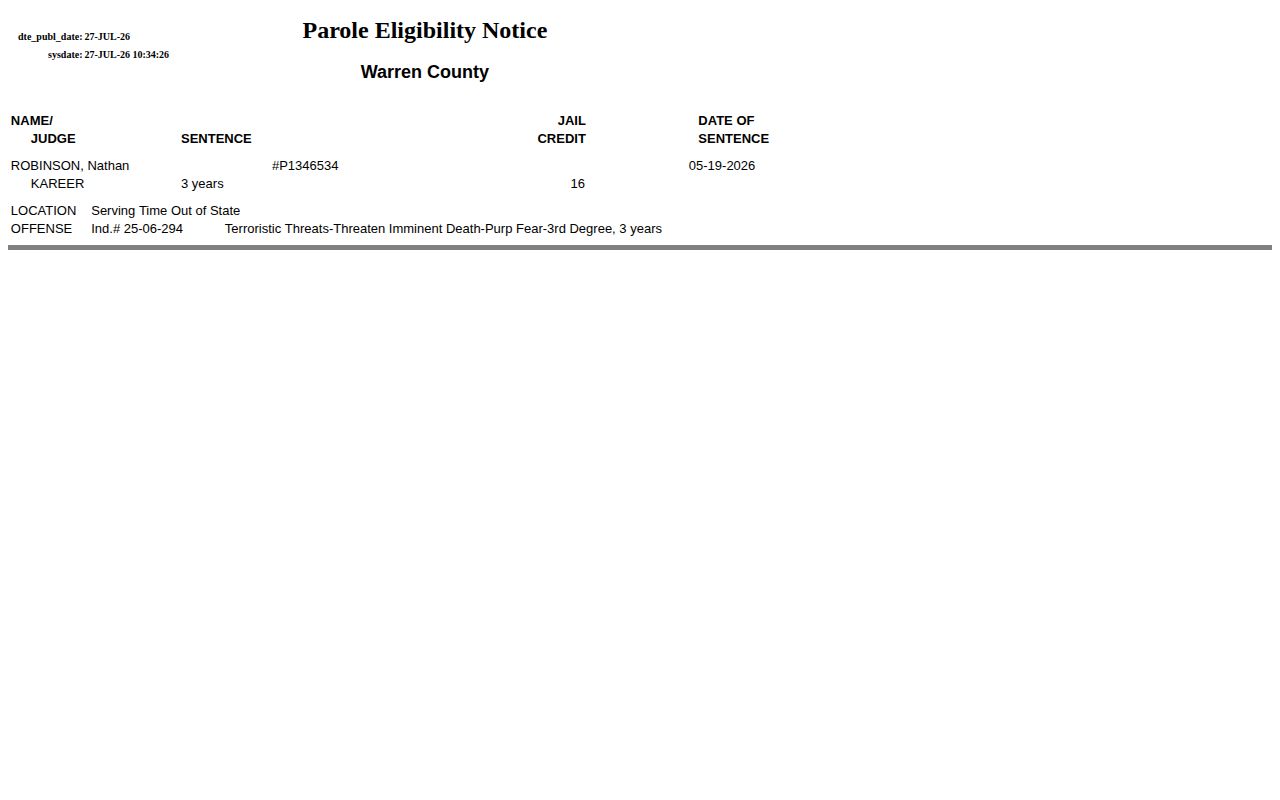
The dated notice helps identify an eligibility event, while NJDOC and the Board supply the later custody and supervision facts.
Note: A Board-set future date remains prospective until the prison release occurs and the correct state record documents that event.
Warren County Parole Absconder Checks
An alleged parole violation may cause the Board to begin violation proceedings. “Absconder” has a narrow meaning here: the person was on community supervision and is alleged to have stopped reporting or left supervision without authorization. The status points back to an earlier release to parole, but it does not prove the person is now lawfully at liberty. Arrest and return to custody may follow.
The NJSPB Fugitive Unit investigates parole absconders. Its official tipline is 1-800-668-7025, and the tip email is SPB-Fugitive-Tip-Submit@spb.nj.gov. The Board’s legacy wanted PDF is not a sound current roster because it contains stale and captured entries. Do not use a missing name there as proof of compliance, or an old entry as proof of present warrant status.
Violation status also needs careful wording. The Board may conduct a preliminary hearing and a revocation hearing after an alleged violation. It can revoke parole and set a future eligibility term, or continue parole with conditions. Probation follows a court process and may be revoked by the sentencing court. A VINE custody alert can show a return to a participating facility, but it does not explain the full violation decision. Match the alert to the Board or court record before describing what happened.
Confirm supervision through the Board, and use the Fugitive Apprehension Unit information for the official reporting channel. If an immediate safety or custody question exists, the agency that owns the warrant or custody event should provide the current fact.
Warren Parole Release Documents
When a person leaves NJDOC custody, the Fair Release and Reentry Act process gives that departing person a portfolio. NJDOC lists a temporary release photo ID, final discharge paperwork, a final trust statement or account balance, and a medical summary. Depending on the case, the packet may also include identity documents, notice of warrants or detainers, transit tickets, referrals, and a supply of medication.
This portfolio is personal proof and a document-recovery path. It is not a public Warren County release list. A family member or other requester cannot assume the state will provide the whole packet as a public record. The released person can use the paperwork to check the release date, conditions, reporting instructions, money, medical needs, and any unresolved hold notice.
The NJDOC release and reentry services page describes the portfolio. For public verification, use the NJDOC history, the Parole Board, or a focused records request instead of seeking private materials held by the released person.
Note: A detainer notice can show why release from one agency did not result in freedom from all custody or legal restraint.
Warren County Supervision Discharge
Physical release, parole, probation, and final discharge are separate points. A person released on parole remains under Board jurisdiction until the applicable term ends. A person on probation remains subject to the sentencing court and probation conditions until the court or supervision record shows completion. Under New Jersey’s No Early Release Act, qualifying violent offenses can also carry a period of parole supervision after the custodial minimum.
A supervision violation can interrupt the path. Probation may be revoked and lead to jail. Parole may continue with conditions or be revoked after the Board’s process. Conversely, reaching the end of a term does not require guessing from elapsed time. The supervising office and final record establish discharge.
For a durable status, keep the matched identifier, judgment or incarceration period, and the agency response together. A Date Out-of-Custody proves the state confinement ended for that period. It does not by itself prove parole discharge. A probation judgment proves the sentence, while the court office supplies the later completion context.