
Warren Projected Versus Actual Release
A projected date is a forecast within an active sentence or custody process. NJDOC calls its future maximum-date field “Current Max Release Date.” The agency defines it as the most recent calculated date after days earned off the term and days added for negative institutional conduct. “Current Parole Eligibility Date” is also prospective. It identifies expected eligibility under Parole Board calculation rules, not a promise that parole will be granted.
An actual release needs completed-event evidence. For state custody, Date Out-of-Custody in the matching incarceration period is the key historical field. For the Warren County Correctional Center, the executed release entry gives the operational date and disposition. A corroborated VINE event can help, while final discharge paperwork may support the released person’s own records.
Scheduled versus actual: A future maximum date, parole eligibility date, tentative jail date, or parole grant date can change. None proves that the person has left custody.
Pretrial custody is different. No sentence exists from which to calculate a maximum release date. Bail or pretrial release, a dismissal, a court order, or a hold may determine when custody ends. Ask the Center about current status and tentative information, then read the Warren court case for the legal action.
Find a Warren County Release Date
Begin by identifying the custodian. A Warren County case can lead to county jail confinement, a state-prison sentence elsewhere in New Jersey, or transfer to another authority. “County of Commitment: Warren” identifies the venue of a state sentence. It does not mean the person is housed in Warren County. Use identifiers such as the SBI number and case number to avoid a same-name mismatch.
- For county jail custody, call the Warren County Correctional Center at 908-475-7900. Ask whether the person is presently held and whether staff can provide a tentative date or identify a hold.
- Check the Warren criminal judgment. It can show the sentence, jail credits, mandatory term, probation, and other court terms, though not always the exact door-out time.
- For state prison, open the NJDOC Offender Search, accept the disclaimer, and search by name or SBI number.
- Confirm aliases, identity details, County of Commitment, current facility, sentence history, and the correct incarceration period.
- Copy the exact label and date: Current Max Release Date, Current Parole Eligibility Date, or Date Out-of-Custody. Record when the search was checked.
- For a completed county event, request the existing release entry if phone information or online sources do not resolve the date.
The Warren County released-inmate record path explains how court, VINE, county records, state records, and federal sources fit together after the event. A projected-date inquiry should stay with the current custodian until actual release is documented.
The manifest’s official NJDOC search capture source leads into the state form and disclaimer.
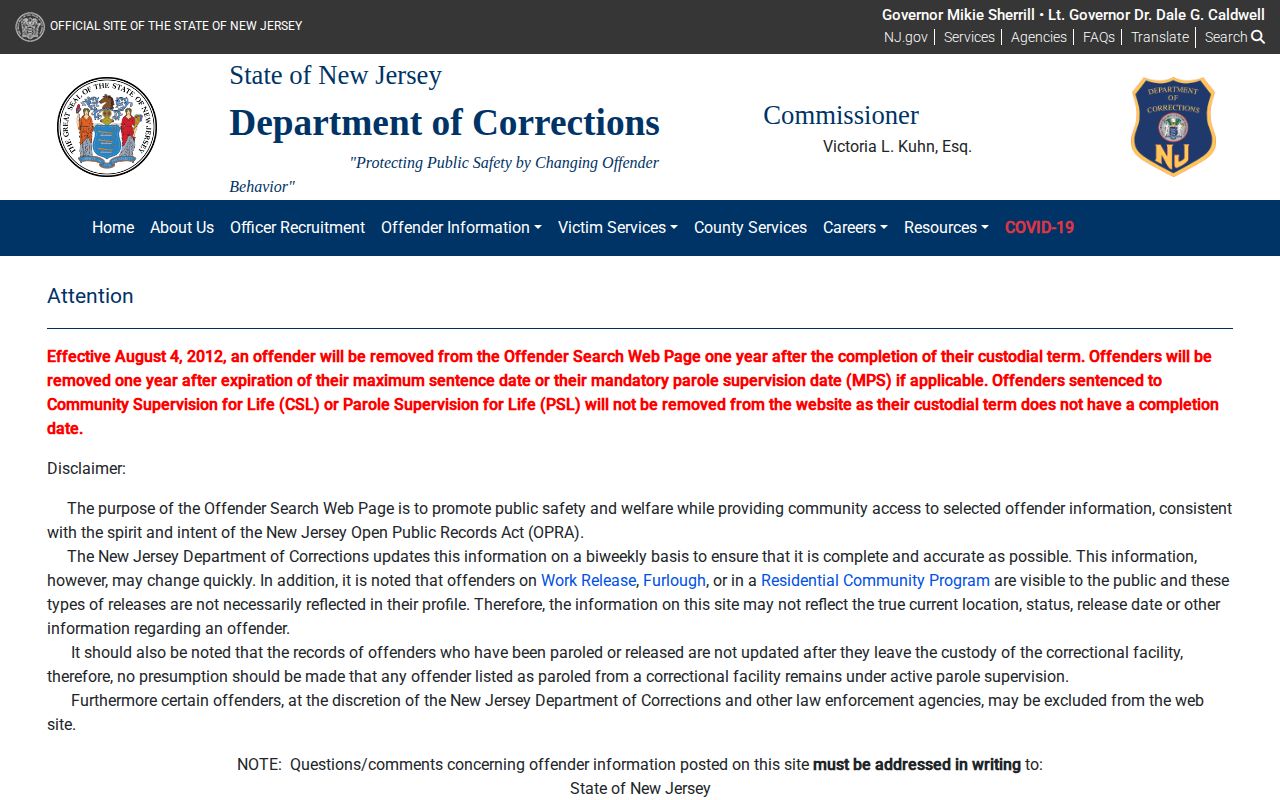
The search form is for NJDOC history and current state commitments, not every person booked at the county correctional center.
Warren Release Dates and Credits
New Jersey sentence calculations can use several kinds of credit. The sentencing judge fixes pre-sentence jail credits. Commutation credits follow the schedule in N.J.S.A. 30:4-140 and may be lost for discipline. Work credits are authorized by N.J.S.A. 30:4-92. The State Parole Board handbook describes work credit as generally one day for each five days worked. It also describes minimum-custody credit as generally three days per month during the first year in minimum status and five days per month after that.
Mandatory minimum terms usually cannot be cut by commutation, work, or minimum-custody credits. Consecutive terms, more than one mandatory minimum, jail-credit allocation, discipline, and changed credit rules can make the arithmetic complex. A person serving a state sentence in a county jail adds another step: county-earned work and minimum credits that affect state parole calculations must be reported by county authorities and certified through NJDOC processes.
The No Early Release Act, N.J.S.A. 2C:43-7.2, applies an 85 percent parole-ineligibility term to enumerated first- and second-degree violent crimes when its conditions apply. It does not cover every New Jersey sentence. The law can also impose post-release parole supervision, so leaving prison may occur before final discharge from legal jurisdiction.
Use the current official calculation. A hand estimate can miss a mandatory term, a later court event, or lost credit. The Legislature’s New Jersey statute search provides the credit statutes, while the official NERA text details that limited 85 percent rule.
Note: Credits can affect a calculated date, but only the responsible agency can apply them to a specific Warren County sentence record.
Why Warren Release Dates Change
A projected release date changes when the facts used in the calculation change. Some changes affect sentence math. Others affect where the person goes on the expected day. A detainer, for example, may end custody at one agency yet begin custody with another. That is a transfer, not community release.
| Factor | Effect on the date or event | Best source |
|---|---|---|
| Earned credit | May reduce the calculated maximum date when law and agency rules allow | NJDOC calculation and sentence history |
| Discipline | Credit loss or added days may move the date later | NJDOC current calculation |
| Mandatory minimum | Can block ordinary credits from shortening the controlling period | Judgment, statute, and NJDOC |
| Parole decision | A grant sets a future Board release date; denial sets a future eligibility term | State Parole Board |
| Rescission review | New information before release can preserve, change, or cancel a parole date | State Parole Board decision |
| Court order or new term | Can alter the sentence structure or legal authority for custody | Warren court record |
| Detainer or hold | May cause transfer to another jail, NJDOC, ICE, or a federal authority | Current and receiving custodians |
A person in an NJDOC halfway house remains in an NJDOC placement. Physical location outside a prison wall should not be called unconditional release. In the same way, Warren County electronic monitoring or the County Labor Assistance Program can place a person outside a secure jail unit while legal custody or program obligations continue.
Warren Max Dates Recalculate Monthly
NJDOC’s field name matters. “Current Max Release Date” is the most recent calculation, and NJDOC warns that it can change at the end of each month. Earned days and negative institutional conduct are part of that recalculation. The date should always be copied with its exact label and the date the state search was checked.
County-earned credits can also matter when a person serves a state sentence in county custody, but those credits need reporting and certification. This is why a home-built calculator cannot replace the state record. It may apply the wrong credit schedule, overlook certification, or confuse parole eligibility with the maximum date.
The official NJDOC field definitions explain Date Out-of-Custody, Current Max Release Date, Current Parole Eligibility Date, and other sentence fields.
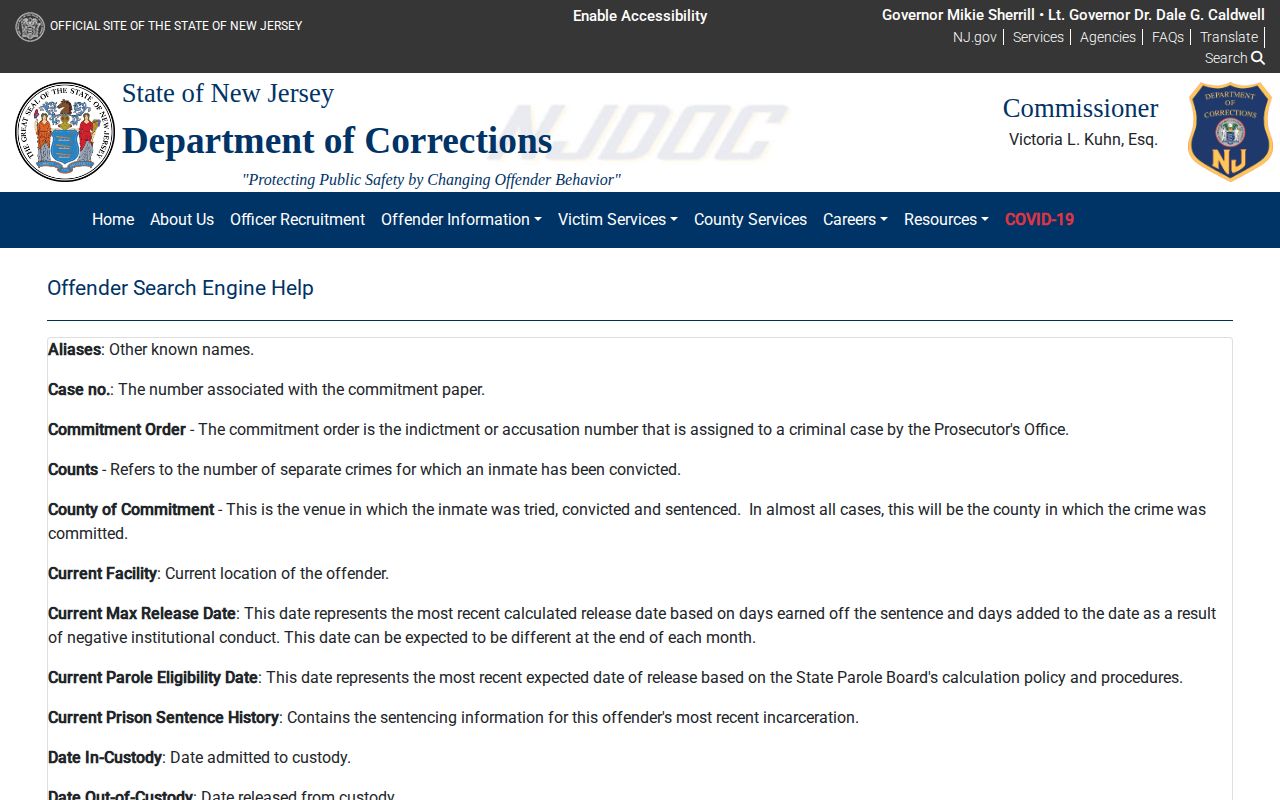
Those definitions separate a completed historical event from a date that remains open to monthly recalculation.
Field check: Date Out-of-Custody is historical. Current Max Release Date and Current Parole Eligibility Date are prospective.
Warren NJDOC Release-Date Field Inventory
The NJDOC detail record contains more than one date and more than one way to match a person. Aliases, SBI number, case number, commitment order, County of Commitment, current facility, and initial admission date establish identity and context. Incarceration history then separates periods of custody. Current prison sentence history connects those periods to offense, sentence, and term data.
Read the fields together. A Date Out-of-Custody belongs to one incarceration period. A later period can show that the person returned to custody. Current Facility may identify a prison, reception unit, halfway house, or other NJDOC placement. A halfway house remains a state placement and should not be described as final release. Current sentence history can include offense degree, offense date, sentence date, sentence length, maximum term, and mandatory minimum term.
| Official field | Use in a Warren County release-date lookup |
|---|---|
| SBI number and aliases | Match the correct state correctional identity before reading dates |
| County of Commitment | Check whether Warren was the sentencing venue, not the place of confinement |
| Current Facility | Identify the present NJDOC placement and whether state custody continues |
| Date In-Custody | Mark the start of the relevant incarceration period |
| Date Out-of-Custody | Document departure from NJDOC custody for that historical period |
| Current Max Release Date | Read the latest calculated maximum date as prospective and changeable |
| Current Parole Eligibility Date | Read expected eligibility, not a grant or completed release |
| Mandatory minimum term | Identify a controlling period that ordinary credits may not reduce |
NJDOC warns that public data can change and may contain errors. A factual dispute about the calculation belongs with NJDOC records, the commitment court, or the State Parole Board, depending on the field. Preserve the search date and the matching SBI number with any copied date.
Confirm Warren County Actual Release
On or after the expected day, recheck the source that owns custody. For a state term, find Date Out-of-Custody in the matching incarceration period and examine whether a later period or current placement exists. For a county event, ask for the Warren Center’s actual release date, time, and disposition. If the person was transferred, follow the receiving agency instead of treating the county booking as the end of all custody.
New Jersey Enhanced VINE can send custody-change alerts for participating state and county records. Register on the matched record and read the agency, event wording, and update time. A transfer alert is not a community release. The Warren County VINE inmate check covers person matching and notification steps.
If sources conflict, favor the custodian responsible for the event. Warren Corrections owns the county door-out entry. NJDOC owns the state incarceration history. The Parole Board owns its decisions and supervision. A court judgment supplies the legal basis, but an unexecuted order does not override a later receiving-agency record that shows custody continued.
Note: Save the identifier, agency, exact field label, and search date together so a later status update can be understood in context.